


News
Mine Rescue Service, DIAMO: The phasing-out of mining brings new safety tasks // Humans of NATO Days
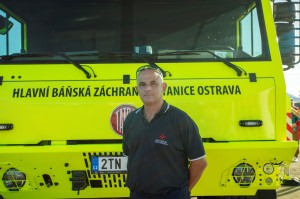
Mine rescue workers from the state enterprise DIAMO are among those you simply cannot miss at NATO Days. While visitors admire the specialised equipment on display, behind each exhibit stand people with decades of experience in extreme rescue operations. In this interview with long-serving mine rescuer and Deputy Head of Emergency Response Jan Šulej, you will learn what it takes to work deep underground, why the decline of mining does not mean the end of mine rescue, and what role DIAMO plays in ensuring safety and shaping the future of post-mining areas.
How did you become a mine rescuer – was it a plan or more a matter of circumstance?
I worked in a mine and constantly saw mine rescuers heading out on operations with breathing apparatus on their backs. I immediately knew I wanted to be one of them and help others.
What is your role at the Main Mine Rescue Station in Ostrava?
I am a trainer for mine rescuers – a first aid instructor, climbing instructor, breathing apparatus instructor, and instructor in monitoring and detection technology. I also serve as Deputy Head of Emergency Response.
Do you remember your very first deployment? What was going through your mind at the time?
Yes, I do. It was an exploration of a mine working more than a kilometre long, with irrespirable conditions and high temperatures. We were using BG-174 breathing apparatus, and I remember telling myself the whole time just to hold on. After the operation, I slept for two days.
How would you briefly describe what it means to be a mine rescuer? What qualities must a good mine rescuer have?
There is one rule: being a mine rescuer is not a job, it is a calling. Our qualities are inscribed in the symbol of mine rescuers, which is based on the Maltese Cross. Each of its eight points symbolises the (knightly) virtues a mine rescuer should possess: piety, justice, intelligence, prudence, kindness, open-mindedness, courage and humility.
The Mine Rescue Service now falls under the state enterprise DIAMO, whose scope is much broader. What does DIAMO do, and which colleagues within DIAMO do you work with most closely?
The state enterprise DIAMO focuses on remediation and land reclamation in former mining areas, and on mitigating the consequences of mining activities, specifically uranium, ore and coal mining. We cooperate most closely with the plant-based Mine Rescue Service unit in Odolov, which now organisationally falls under the Main Mine Rescue Station in Ostrava.
How does a mine rescue operation differ from the work of the ambulance service or other emergency services?
Mine rescue tactics are very specific. We operate according to service regulations, particularly the operational code derived from them. Compared to other Integrated Rescue System units, our deployments are often longer and carried out in extreme conditions – whether heat, reduced visibility, confined spaces, risk of explosion or contaminated air.
How often do you respond to incidents that are not underground? How have you used your skills in such cases?
So far, there have been fewer of those operations; we were primarily prepared for underground interventions. Now that the mines have closed, this should change and, if requested by the Integrated Rescue System, we should also respond to incidents on the surface.
As Deputy Head of Emergency Response, you descend into the mine during operations while the commander remains on the surface. How do you communicate, and what decisions can you make if communication is lost?
In my 31 years as a mine rescuer, communication between me and the incident commander has never been lost. It is secured multiple times over, even underground. If it were to happen, I would follow the service regulations.
What tends to attract or surprise visitors most at the DIAMO stand?
Usually it is our UNIMOG 2150 L dive support vehicle, which is used to transport divers and is equipped with a decompression chamber.
At NATO Days you also presented a lifting device that allowed visitors to be raised into the air. Do mine rescuers work at height as well?
Most visitors thought it was a crane, but to clarify, it is a mobile winding unit, the MHDZ Ipex 1300, capable of transporting – or hoisting – up to five people from depths of up to 1,300 metres. But yes, mine rescuers also work at height and above open drops. We are properly trained for that.
What would you like visitors to take away after visiting the DIAMO stand at NATO Days?
I would like us to be able to answer every question asked. Over the years I have attended NATO Days, there have been countless questions. I always prepare thoroughly in advance.
How does the phasing-out of coal mining in the Czech Republic affect the activities of DIAMO and mine rescuers?
The decline of mining does not mean the end of work for mine rescuers – on the contrary, it brings new safety challenges. It increases the importance of the state enterprise DIAMO and of mine rescuers, as they assume responsibility for the safe closure of mines, the removal of environmental damage and long-term monitoring of former mining areas, which significantly broadens our scope of work.
International cooperation is an important theme at NATO Days. Which foreign partners do you work with?
We cooperate with mine rescuers from Poland and Austria, organising joint exercises and sharing experience.
|
|

In addition, you are also a self-defence and karate coach. How did you get into that, and how do these skills help you in your work as a mine rescuer?
I have practised karate for over 45 years and hold a 4th DAN – the fourth black belt level; there are ten in total, with the highest being red. I have been coaching for more than 20 years. How does it help me? I am not sure, but sometimes I notice a greater level of respect from colleagues because of it.
What would you say to young people considering a career in mine rescue?
You might not believe it, but there is enormous interest in becoming a mine rescuer, especially after NATO Days. What would I tell them? You must be prepared to keep developing professionally – in first aid, climbing and diving. Firefighting and working with breathing apparatus are, of course, essential.
Is there anything you would like to say in closing to visitors and fans of NATO Days that has not yet been mentioned?
During NATO Days I have been asked countless times when our mine rescue service will be dissolved and what we will do once there are no more mines. There is only one answer: we will never be dissolved, and we will always remain 100% ready to assist all components of the Integrated Rescue System.
Zdař Bůh!
Partners














.jpg)