


News
Mjr Miroslav Hovorka, Czech Air Force: flying a helicopter is teamwork // Humans of NATO Days
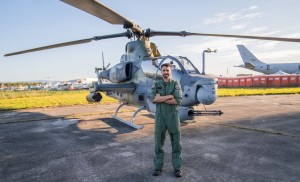
What does the job of a military pilot involve? How do the Venom and Viper helicopters differ, and in what ways are they similar? And what fascinates a pilot who began his career on the Mi-24? Major Miroslav Hovorka — a pilot and AH-1Z Viper instructor, currently, as he himself put it, “seconded” to the Czech Air Force Command — shared this and much more with us.
Could you briefly introduce yourself — who is Miroslav Hovorka and what exactly does your job at the 22nd Helicopter Base involve?
I am Major Miroslav Hovorka. I was recently promoted and temporarily “seconded” to the Czech Air Force Command, but I still see myself first and foremost as a helicopter pilot through and through. I return to Náměšť very often — both to fly myself and because I serve as an instructor on the AH-1Z Viper.
My work today is no longer just about flying. It now also includes activities connected with operating the H-1 system at higher command level. I see it as an opportunity for further professional growth, but the foundation remains the same — I am a pilot.
Do you remember the moment you first decided you wanted to become a helicopter pilot? What attracted you most at the time?
I probably couldn’t pinpoint the exact moment. However, the desire to do something meaningful had been with me for a long time, and I was strongly inspired by air rescue services. The Army offered a pathway to air rescue as well as top-level pilot training, so it was a logical choice for me. I was drawn to the combination of expertise, responsibility and purpose.
Although I ultimately found myself in attack helicopter aviation, the idea of air rescue has stayed with me — perhaps one day after active service.
Do you remember your very first helicopter flight? What emotions and thoughts accompanied it?
I vividly remember our first flights more from the position of spectators. Instructors demonstrating take-offs, hovering and landings with such ease that it looked as if the helicopter were on autopilot. Then reality arrived. When we first took the controls, it was a mix of euphoria, absolute survival mode, and trying to control our own limbs. Every movement triggered three opposite ones; the helicopter seemed to have a will of its own, and we were sweating, engaging muscles we didn’t even know existed. Naturally, the instructors found it quite amusing.
But in the end, we tamed those “infernal machines” — and today they are our daily bread.
What do you enjoy or find most fulfilling about flying helicopters?
Without question, the helicopter’s versatility. The ability to take off from almost anywhere and land nearly anywhere is unique. I am fascinated by low-level flying, manoeuvring through valleys, masking behind terrain, and the intense sense of speed created by proximity to the ground — something fighter pilots, even though they fly much faster, will never experience in the same way. Above all, helicopter aviation has a clear purpose. That is essential for me.
Is there a particular moment during flight when you think, “This is exactly why I do this job”?
On a personal level, it is that feeling of freedom and the childlike “wow” that will probably never disappear from our flying.
Professionally, it is the moment we master a new skill or achieve precision on the firing range. As combat pilots in peacetime, our main aim is to keep getting better. Every small success is exactly the moment when you say, “Yes — this is why I do it.”
The H-1 system helicopters appeared here relatively recently. You fly the AH-1Z Viper. What was your journey to its cockpit? Is it possible to fly both the Venom and the Viper?
In the Czech Republic, multi-type helicopter flying is not currently practised, although it may be considered in the future. Although the H-1 helicopters are largely similar and share many components, their handling philosophy and roles differ. I personally fly the AH-1Z Viper — an attack helicopter with a tandem crew arrangement (we sit one behind the other) and the specific feature that the cyclic control is on the right-hand side of the cockpit rather than between the legs, as is common in other types.
My path to the Viper was partly shaped by my previous experience on the Mi-24. The transition from the “Hind” to the AH-1Z made sense both tactically and in terms of the roles an attack helicopter fulfils within the Czech Armed Forces. The training was intensive — you carry over certain habits, but at the same time you must rebuild automatic responses to match new ergonomics, avionics and weapons systems. The Viper brings precision, situational awareness and capabilities that were previously unavailable in such combination.
My journey began at the Flight Training Centre in Pardubice on fixed-wing Z-142 CAF aircraft, before transitioning to Mi-2 and EN-480BG helicopters.
How difficult was it to say goodbye to the Mi-24? Did you feel nostalgia?
I was among the last pilots trained on that aircraft. I heard hundreds of stories about the “old warhorse” and met many people who devoted much of their careers to it. Even its silhouette on the horizon commanded respect, and flying it had its own unmistakable dynamism and character. On the other hand, its equipment and capabilities no longer reflected the realities of today’s battlefield — something clearly demonstrated by the H-1 system. As I mentioned, transitioning from the Mi-24 to the AH-1Z makes sense both tactically and in terms of operational roles. So I bid it farewell with a symbolic tear in my eye, closed one major chapter, and enthusiastically embraced training on the far more modern H-1 platform.
The H-1 helicopters are said to be very similar and share many components. From a pilot’s perspective, how do they differ when performing different missions?
Although the H-1 helicopters are approximately 85% technically identical, the differences are significant for pilots. The commonality primarily concerns assemblies and interchangeable parts, which is excellent from a logistics standpoint. However, in the cockpit and in mission execution, the two types diverge considerably.
The first major difference is cockpit layout. In the UH-1Y Venom, pilots sit side by side and usually have at least one additional crew member in the rear.
In the AH-1Z Viper, it is a completely different world. We sit in tandem, so we cannot see each other, making communication far more structured and precise. Every piece of information must be clearly verbalised — there is no room for gestures. This changes cooperation and the overall flight dynamic.
Mission profiles also differ. Engaging a target at long range using onboard sensors and precision-guided munitions is entirely different from transporting an assault team to a landing zone using fast-rope techniques. While cockpit systems are very similar — we work with the same displays and control logic — the purpose, tactics and required skills differ.
Do you have a humorous or interesting story from your career?
There are plenty, but not all are publishable — and others would lose their punch without context. However, here is a classic aviation joke. In the armed forces, everyone needs stars in some way. Infantry sleep under them, sailors use them for navigation, and airmen need them for both — because they choose their hotel according to the stars.
You were part of NATO Days in Ostrava & Czech Air Force Days last year. What is it like presenting your work and helicopter to such large crowds?
It is part of our job and a pleasant duty. In peacetime, it is important to show people what we are prepared to defend the country with. I have been impressed by the scale of NATO Days in Ostrava & Czech Air Force Days for several years now. I enjoy people’s curiosity and answering their questions.
One touching moment involved a young boy from Poland, a huge aviation enthusiast, who shyly told me he admired our Viper and saw us as role models. He gave me a beautiful hand-drawn picture of our helicopter with a dedication. I still have it displayed in my office.
What might the public not realise about everyday life at a helicopter base?
People often imagine that a pilot’s life is mainly about flying. Most of us would not object to that, but reality is different. First and foremost, we are soldiers — which brings many duties unrelated to the cockpit: physical fitness tests, live-fire training, field exercises. Then there are specialised activities indirectly connected to flying, such as survival training in the wild or in captivity. Only afterwards come activities directly related to aviation: studying constantly changing regulations, analysing dynamic airspace conditions, planning operations and international exercises, or training new pilots. There is a great deal to keep up with. Sitting in the cockpit and practising the true craft of flying is the proverbial icing on the cake.
What is the greatest challenge a pilot faces?
Before every flight, a pilot must critically assess risk. Conditions can change rapidly with time, environment or weather. Although most pilots naturally want to take the controls and fly, it is not always within acceptable safety margins. Ultimately, we all battle our own egos. Sometimes it is difficult to admit we are not fully fit, not perfectly prepared, or that the weather no longer allows safe completion of the mission. Being able to say “not today” may be one of the hardest but most important skills of a pilot. We manage it through thorough preparation, training and systematic evaluation.
How do you switch off when you are not flying?
When I am not flying, what recharges me most is… flying. This time as a passenger, exploring the world. Travelling energises me — whether far away or just around the corner. I love discovering the Czech Republic as much as travelling abroad. We have a beautiful country full of remarkable places. The best way for me to clear my head is to take a rucksack and head into the countryside — even just for a simple hike in the hills. It offers peace, space and freedom — almost like being in the air. I also practise scuba diving, where I again find calm and a sense of freedom.
|
|
Has your view of the profession changed over time?
Naturally. As one matures, one begins to see the broader context. The original motivation of “I want to fly” evolves into a clear understanding that the primary mission of a military pilot is to be fully prepared when national defence or crisis situations require it. Flying itself is no longer the ultimate goal but part of a greater purpose. Today I see much more teamwork and preparation behind every flight.
What message would you like people to take away from meeting you and your helicopter at NATO Days in Ostrava & Czech Air Force Days?
I would like people to understand that we are ordinary individuals doing a job we love — and we are happy to share part of it. At the same time, soldiers ultimately represent political will. Some things may not make sense at first glance, and others we cannot describe in detail for security reasons. Events like NATO Days in Ostrava & Czech Air Force Days show that we strive to remain close to the public — through our profession, our capabilities, and our openness in explaining what we do and why. We want to reassure the public that defending our country and its sovereignty is an absolute priority — and that we are prepared to fulfil it not only with advanced technology, but with personal commitment.
What would you say to young people considering a career as a military helicopter pilot?
It is about determination and dedication to serving your country. Training will test everyone — you need good health, fitness and logical thinking. With motivation and hard work, success is possible. And what is the most beautiful aspect? Flying itself.
And teamwork — flying a helicopter is collective effort, shared responsibility and shared success.
Partners














.jpg)
.jpg)