


News
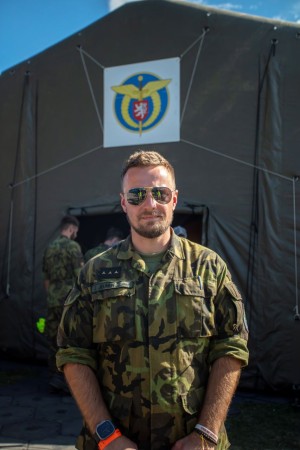
1LT Jakub Jelínek, Czech Air Force: We have a complete overview of the situation // Humans of NATO D
What happens when a passion for aircraft and aviation takes over? For 1LT Jakub Jelínek, it means becoming a combat air traffic controller. He recently returned from France, where he completed NATO Intermediate training. You may have also met him in Mošnov – at the Czech Air Force stand or at the presentation of the 26th Air Command, Control and Surveillance Regiment, which he is responsible for. But what exactly does a combat controller do? How are aircraft directed when you do not have a view of them? And what can you find at the Czech Air Force stand at NATO Days in Ostrava & Czech Air Force Days?
Could you introduce yourself to begin with?
My name is Jakub Jelínek, I am 37 years old, and I joined the armed forces relatively late – at the age of 29. I originally pursued a different professional path, but eventually my long-standing passion for aviation and aircraft prevailed. Today I serve as an air traffic and combat control (Intercept Controller) officer at the 261st Control and Reporting Centre of the 26th Air Command, Control and Surveillance Regiment.
What brought you to the armed forces, and specifically to the 26th Air Command, Control and Surveillance Regiment? Did little Jakub dream of becoming a soldier one day?
Despite the fact that little Jakub often used to visit his grandparents at the garrison in Stará Boleslav, where I also grew up, and although we have a military tradition in the family, it never really occurred to me. In truth, it was more of a coincidence – or perhaps fate.
How does the work of a civilian and a military air traffic controller differ?
Quite significantly. The fundamentals are the same – we control aircraft by heading, altitude, and sometimes speed, just like in civilian air traffic control. However, the combat role is very different. It is no longer just about controlling aircraft; instead, you provide pilots with critical information, create a comprehensive picture of the situation for them, assign tasks, and at the same time pass their information further up the chain of command. It is essentially an extension of standard air traffic control, complemented by a form of overall operation management.
What should we imagine under a combat controller? You probably do not tell fighter pilots where to fly…?
Exactly. In actual combat, the pilot develops their own tactics, or these are coordinated between pilots themselves. Our role is to provide them with information about where enemy fighters are located, where ground-based air defence systems are, and so on. We alert them to new threats that change rapidly in the dynamics of combat, and we can also offer tactical recommendations because we have a comprehensive overview of the entire situation on our radar display. That is why it is essential for us to understand the tactics and dynamics of air operations. And sometimes, it is just as important to know when to remain silent – for example, when the pilot is fully occupied. That is also a sign of a good controller.
The common perception is that air traffic controllers sit in a control tower at an airfield with a clear view, whereas a military control centre is located far from the airfield. Can you describe this workplace in more detail?
It is important to say that we also have a perfect overview of the situation – precisely because our workplace is part of NATO’s integrated air and missile defence system. In a sense, it represents the “brain” of the air forces and air defence, and we have an overview of what is happening not only in our own airspace, but also in a broader international context. What we naturally lack is the visual contact with the aircraft – for us, they are always just “dots” on a screen. Unlike a control tower, we therefore do not work with an outside view, but in an environment full of screens, data, and information from which we build the overall picture of the situation.
What does a typical working day of a combat controller look like? Is there even such a thing as a “typical” day for you?
A shift of course has its fixed points, such as the morning briefing and handover, but otherwise every day is different. There are periods of relative calm, when we prepare for upcoming tasks, and then moments or large-scale exercises when the situation changes rapidly and demands maximum concentration. This may involve cooperation with JTAC (Joint Terminal Attack Controllers) and practising close air support for ground units, or a tanker may arrive and we train in-flight refuelling, or we focus on air combat scenarios, which vary widely depending on the current exercise being conducted. From relative calm, you can very quickly find yourself in a highly dynamic operational environment.
Do you encounter in practice that people have a mistaken idea about your position/role? What do they most often get wrong?
A lot of people are not even aware that this kind of job exists, so for most of them it is difficult to imagine it at all. This is also because it is not easy to explain, and of course there are things we cannot share or describe in detail.
You recently also completed NATO Intermediate training in France. Could you describe this training for us?
As a combat controller, there are three licence levels – NATO Basic, Intermediate, and Advanced – which determine how complex missions and how many aircraft you are authorised to control.
The Advanced course cannot practically be completed in the Czech Republic due to the complexity and demands of the missions, as we unfortunately do not have the necessary capacity. The same applies to the Intermediate level. We have been completing Advanced courses in France since 2021, and since this year we have also been attending the Intermediate level there, which significantly shortens the time needed to obtain this qualification compared to relying solely on our own national capacity.
From the Intermediate level onwards, you deal with complex scenarios of more sophisticated air operations, including, for example, the transition from a crisis situation to an open armed conflict.
How does cooperation within NATO work, apart from joint training? Do you deploy to missions or to allied countries to control air operations?
Together with the Gripen pilots, our colleagues were deployed last year as controllers in Iceland, and in the past we also went to the Baltic states, where they now already have their own fully trained personnel. We also occasionally take part in some major exercises abroad, although these are lower-level exercises in recent years. It would of course be better for us to deploy more often and gain valuable experience from large-scale operations. At the end of May, several colleagues will head to a major exercise, Ramstein Flag, in Sweden.
Conversely, in the Czech Republic we sometimes control training missions between Czech Gripens and German Eurofighters, and more recently also Slovak F-16s. Two years ago, for example, we took part in the large exercise of Gripen operators called Lion Effort. We also conduct in-flight refuelling with NATO tankers, but overall these are rather smaller-scale missions.
At NATO Days in Ostrava & Czech Air Force Days, you were responsible for the Czech Air Force stand. What can visitors see there, and why should they definitely not miss it?
The Czech Air Force stand is designed to show visitors the true breadth and complexity of tasks carried out by the Czech Air Force. It is not just about aircraft in the air – visitors can see a comprehensive picture of how individual components work together so that the whole system functions as one organism. All main branches of the air force are represented there, so people can better understand everything that stands behind every take-off of an aircraft or helicopter they see in the sky.
At the same time, the stand meaningfully complements the dynamic and static displays, allowing visitors to ask questions, discuss, and understand the wider context.
|
|
Besides the Air Force stand, you are also responsible for the presentation of the 26th Air Command, Control and Surveillance Regiment at NATO Days in Ostrava & Czech Air Force Days. What can visitors see there?
The main static display is, of course, the mobile radar EL/M-2084 MADR, where visitors can learn how the radar works, what information it provides, and how that radar data is subsequently processed.
At the same time, we also try to present the full breadth of tasks performed by the 26th Regiment, because it is truly very wide-ranging. It is not only about radar units or combat aircraft guidance, but also about evaluating the air situation and distributing that information within the Czech Armed Forces and NATO. We also provide, for example, the Military Rescue Coordination Centre, participate in coordination with civil air traffic control, and are responsible for military aeronautical information services, among many other tasks – all of which we try to bring closer to visitors.
As I mentioned, our work is very difficult to explain, and people do not normally encounter it in everyday life. That is why I am all the more pleased that, in cooperation with the University of Defence, we were able last year to bring an air traffic control simulator to NATO Days, allowing visitors to experience first-hand what the work of a controller actually looks like in practice.
What would you say to someone who would like to work in military air traffic control one day?
I would tell them not to be afraid of it. It is a demanding and highly responsible job, but at the same time extremely interesting. You have to realise that a long and challenging training process lies ahead, but the result is worth it – I would definitely not change my choice.
Is there anything you would like to add at the end?
I would definitely like to invite everyone to the next edition of NATO Days in Ostrava & Czech Air Force Days. It is a unique event of its kind in the Czech Republic, and the atmosphere there is truly impossible to describe – it has to be experienced
Partners














.jpg)