


News
CAPT Radek Vrabec, Ground Forces: I've been drawn to challenges not for all // Humans of NATO Days
What does it all mean to be the “eyes and ears” of a commander in the field? CAPT Radek Vrabec, who serves as deputy commander of a reconnaissance company with the 102nd Reconnaissance Battalion in Prostějov, helped us find out. In this interview, he talks about his path into airborne reconnaissance, demanding training, and why there is no such thing as a stereotype in his line of work. He also shares his experience from overseas deployments in Afghanistan and Mali, his involvement during the pandemic in hospitals, and cooperation with helicopter aviation during displays at NATO Days in Ostrava & Czech Air Force Days, as well as beyond them.
Could you introduce yourself to begin with?
I have been serving in the Armed Forces of the Czech Republic for fourteen years, and I currently hold the position of deputy commander of a reconnaissance company with the 102nd Reconnaissance Battalion in Prostějov. For me, my work is a combination of discipline, continuous self-improvement, and responsibility for the people I command and serve alongside.
Why did you decide to join the Armed Forces of the Czech Republic?
It wasn’t a complete coincidence. I’ve always been drawn to challenges that aren’t for everyone, and to an environment where one’s word and character truly matter. I wanted to pursue a profession with a deeper meaning — one that would test me both physically and mentally, and offer an adventure that is difficult to experience in ordinary civilian life. In the Army, I found exactly the balance between responsibility and action that I was looking for.
You completed your studies at the Training Command – Military Academy in Vyškov with an award for the best graduate. Was that your goal? And does the ceremonial sword have a place of honour?
Yes, as you mentioned, I completed my studies at the Training Command – Military Academy in Vyškov with the award for best graduate. To be honest, receiving the award was not my primary goal. I joined with the intention of getting the most out of myself, improving, and gaining new knowledge and experience that I could later use within my unit. The most important thing I took away, however, were the new friendships and bonds with people that still last to this day. The fact that I ultimately achieved the best results, I see as a kind of sweet finishing touch. As for the sword, it of course hangs in my office in a place of honour, but I do not consider it the greatest achievement of my career. I regard winning the reconnaissance patrol competition as my biggest success, and that is the one I reflect on far more often.
You are the deputy commander of a reconnaissance company within the 102nd Reconnaissance Battalion in Prostějov. What does your typical working day look like? What does your job involve?
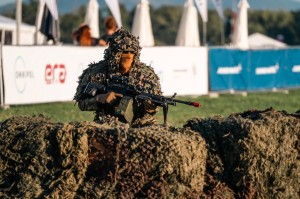
You won’t find any routine in our work. As the officer responsible for training, I spend a lot of time planning exercises and handling administration, but the core of my job is being out in the field with the unit during training. We focus mainly on physical conditioning, marksmanship, and tactical preparation, which go hand in hand. One doesn’t work without the other in real operations. Our work is very specific, and high demands are placed on every individual. We are an airborne unit, so our deployment also involves parachuting, which requires precision and absolute focus. This is also why we proudly carry the name of the 102nd Reconnaissance Battalion of General Karel Paleček. General Paleček was the founder of our airborne forces.
What should we imagine under the term “reconnaissance”? What tasks do you carry out?
In our concept, reconnaissance is a complex activity focused on gathering timely information about the enemy and the terrain. We are essentially the commander’s “eyes and ears.” Our task is to covertly infiltrate areas of interest, whether close to our own forces or deep in the enemy’s rear, and collect data that is critical for decision-making and the success of the entire operation.
In practice, this means long hours of concealed observation, monitoring the movement of equipment, or identifying targets — in any weather conditions and in any environment. Information is the most valuable asset in modern conflict; it allows us to anticipate the opponent’s actions and eliminate surprise. Reconnaissance is therefore not only about the courage to be on the front line, but above all about patience, precision, and the ability to analytically assess what we observe in the field.
During the display at NATO Days you work with the 22nd Helicopter Base. Does this cooperation look the same as what visitors can see, or how does it differ in practice?
The public display is an impressive show where timing and visual impact are key. In reality, it is much more demanding and “raw.” Our cooperation with the 22nd Helicopter Base is a regular and integral part of our unit’s training. While people at NATO Days see the adrenaline and action, behind it are hours of dry rehearsals focused on detail, precision, and strict adherence to safety procedures, ensuring nothing happens to soldiers, equipment, and above all, the spectators.
You also tried the role of commentator. What is closer to you — observing the unit from a distance, or being directly involved in the action?
That’s a difficult question. I participated in NATO Days three times as a group commander, leading a reconnaissance team directly during the event. Of course, I miss the adrenaline and being part of that dynamic display. This year, however, I experienced the opposite role for the first time. I was involved in planning, attended coordination conferences, and directed the display from the control tower, where I also provided commentary. It was a great and valuable experience for me. I could see the enormous amount of work behind it all — you realise how demanding it is to coordinate everything, from logistics to often second-by-second synchronisation with the air force. Even though I am still drawn to being in the field during action, I am glad I had the chance to look behind the scenes and see the bigger picture. Both roles have their value, and both have moved me forward.
Have you taken part in any missions? If so, could you briefly describe them?
I have taken part in missions, for example in Afghanistan and in Mali in Africa. There are many experiences from those deployments — both good and difficult. A mission will significantly develop you as both a person and a soldier. The intensity of training and real-world operations there is much higher than in home conditions. Being separated from family and friends for six months teaches you to appreciate things we often take for granted at home. For many soldiers, these experiences fundamentally change their lives. Professionally, it shapes you. The strongest experience for me remains the incredibly close bond within the team. In extreme conditions, you find out who the people around you really are, and at least in our unit, it has deepened professional relationships into something closer to a family.
Together with other colleagues, you were also deployed on a difficult domestic “mission” during the coronavirus pandemic, helping in hospitals. In one interview you mentioned that it was especially demanding psychologically — being in close contact with patients without their families for many weeks, and at risk of infection, must have been very difficult. How do you look back on this period with hindsight?
I look back on that period with great respect. Our group from Prostějov was among the first that the Army sent into hospitals. We did not know what to expect. It was something completely different from what we are normally trained for. Instead of tactics and weapons, we had to deal with basic patient care, assist with hygiene, and often simply be a human support for patients. It was emotionally very difficult. In hospitals, we encountered many strong and often sad stories of people fighting for their lives without the possibility of having their loved ones by their side. However, it also showed us that our cooperation with the integrated rescue system is meaningful, and that helping our citizens in times of crisis is just as important as any other military task.
|
|
Is there anything people would never guess about you?
It might be tempting to say that, as a paratrooper, I’m afraid of heights, but that would be a lie — I really don’t mind them. However, many people are surprised when I tell them that, given my build and appearance, I absolutely refuse to watch horror films with them. I truly don’t like them because I simply get scared. Everyone has their own fears, and I prefer to get my adrenaline in real operations rather than at home in front of the TV.
What would you like visitors to take away from NATO Days — after seeing the demonstration you commented on or visiting the static display of the 53rd Reconnaissance and Electronic Warfare Regiment?
I would like people to leave NATO Days with the understanding that while our equipment is impressive, its true strength lies in the people — professionals who are willing to make significant sacrifices for the security of this country. I want them to leave with the feeling that they have an army they can rely on at any time. In today’s world, it is more evident than ever that security is not something to be taken for granted, and being part of such a strong alliance gives us certainty that we would struggle to achieve as a standalone state.
What would you say to someone considering a career in the Armed Forces of the Czech Republic?
I would say that the Army is not just a job, it is a way of life. If you are looking for an easy path, this is not it. But if you want to find out where your real limits are, gain colleagues and friends who will never let you down, and do something that truly has meaning, then don’t hesitate. Be prepared for hard work, but trust me — when you put on the uniform for the first time and know you made it, it is worth it.
Partners














.jpg)