


News
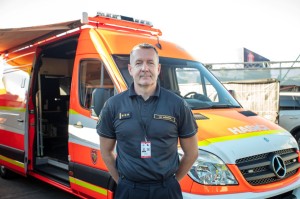
LTC Mariusz Łapeta, AGAT: Service in the Special Forces feels like a family // Humans of NATO Days
Lieutenant Colonel Mariusz Łapeta has served in the Polish Special Forces for more than 20 years. He began his career with the Military Police in Gliwice and later served with the elite AGAT unit, where he was also involved in training young soldiers. He completed civilian studies at the University of Physical Education and gradually worked his way up into the command structure of the Special Forces. In the interview, he describes the reality of serving in elite units, the demanding selection process, and his deployments in the Middle East. He also highlights the importance of international cooperation within NATO and the role of Special Forces in today’s security environment, including the fight against disinformation. He shares a personal perspective on service, which he believes is built primarily on people and mental resilience.
Could you introduce yourself to begin with?
I am Lieutenant Colonel Mariusz Łapeta, spokesperson for the Polish Special Forces.
What inspired you to join the Armed Forces of the Republic of Poland?
I joined the armed forces straight after my studies, at a time when compulsory military service was still in place – as they say, we were called up. I found that I liked it, and I was offered the opportunity to stay. I am a graduate of civilian studies, having completed the University of Physical Education. That is how my career developed. This year marks 20 years of service, and every single day has been different.
Did you dream of becoming a soldier as a child?
Probably not. At first, I was thinking about a career in the police; I found it very interesting. But in general, I always wanted to wear a uniform because I cared about helping people. I wanted to face threats and act in a way that would make the citizens of my country feel safe. That strongly appealed to me. I also saw older colleagues in uniform and tried to work towards the day when I could wear one myself.
So what did your path into the Special Forces look like?
I began my service in a Special Military Police unit in Gliwice. Later, I joined the AGAT unit, also based in Gliwice, which – incidentally – was later reorganised. For a long time, I worked in the training department there. I trained young soldiers in physical fitness, marching, climbing, and skiing. It matched my education and my role as head of the physical training section.
At present, I serve within the Special Forces component, meaning within their command structure – a separate branch of the Armed Forces of the Republic of Poland. The Special Forces are the fifth and smallest branch of the armed forces, but as we always emphasise, it is not about quantity, but quality. We also follow the principle that people matter more than equipment.
We can observe the situation in Ukraine – equipment can always be supplied, but trained personnel cannot be replaced. Unfortunately, reaching such a level of training takes a long time and, importantly, not everyone is suited to it.
What does a typical day for a Special Forces soldier look like?
It is difficult to talk about a “typical” day, because in this line of service no two days are the same. In practice, however, we spend most of our time away from home.
I would like to express my great respect and gratitude to our families, who endure our absence and, to a certain extent, accept it. We often travel, not only within our own country but also abroad. We cooperate with many NATO countries, including the Czech Armed Forces, whom we hold in very high regard as a partner.
In connection with the floods in 2024 – there is a saying in Poland that true friends are known in times of need. And indeed, it turned out that the assistance of our colleagues, the pilots who operate helicopters, highly specialised and unique within NATO armed forces, made it possible to save several communities affected by the floods.
What missions and tasks do Special Forces units most commonly carry out?
Special Forces are an elite formation. They are deployed wherever crisis situations occur around the world – to prevent them and to ensure that threats do not reach our country or other NATO states. They are small, highly trained and well-equipped teams. We very often operate abroad, carrying out missions aimed at neutralising threats directly at the source, before they can spread further. We operate all over the world.
What missions have you taken part in?
I took part in a mission in the Middle East. It is a very unstable and dangerous region, which is particularly close to me. I have been to Lebanon and Syria several times. These are places where the situation remains difficult to this day. I believe that if Special Forces had intervened in time and stability had been maintained, things might have looked different.
What was your role on these missions?
I served as a platoon commander when I was a young officer. I was responsible for planning and executing patrol tasks. It was also a very difficult mission, as six of our Spanish colleagues were killed there. We were deeply affected by it. I also developed close relationships with Spanish soldiers. The farewell to our fallen colleagues at the Cervantes base in Lebanon was particularly difficult.
Service in the Special Forces is not for everyone – only the best of the best get in. How does one achieve that?
The standard is set very high. The key is not only physical fitness, which must be developed continuously through daily training, but also taking care of oneself in many other areas, including nutrition. We are constantly developing our skills and abilities. You could say that in many areas we are, in a sense, pioneers.
Psychological resilience is also very important. Psychological testing, the selection process, and six days of mountain operations that must be completed in order to even enter the service mean that, in practice, military rank becomes less important and the individual matters most. I often meet colleagues who differ from me only in rank. They have similar education, language skills, and operational experience – the only difference is that I have served longer, so I simply have more “stripes”. It is precisely this that makes service in the Special Forces feel like a family. We are very closely connected and operate as one team.
Regardless of which unit we serve in – there are five Special Forces units in Poland. One of them is the AGAT unit in Gliwice, known as the “salt of the black earth”. It is a truly elite formation that has become firmly established not only within the structure of the Polish Armed Forces but is also recognised internationally, which makes me very proud, as I had a role in its creation.
How has your view of the world changed during your service?
I have become more aware. We, as soldiers, have access to more information regarding threats and the security situation. We live in a time of so-called hybrid warfare – non-kinetic operations carried out, among others, by the Russian Federation and the armed forces of Belarus.
How do you assess the situation at the border and the overall migration pressure?
Every day, 365 days a year, seven days a week, 24 hours a day, approximately 17,000 Polish soldiers guard the border to prevent illegal migration into our country.
This is particularly important because there are cases where individuals crossing the border may have various links or experience that could potentially pose a threat. That is why service at the border and countering these phenomena is so important.
For the first time in my life, I have encountered situations where forces that, by their very nature, should be protecting the border have in some cases facilitated illegal crossings. Therefore, we must do everything on our side to prevent this.
This does not concern only our country, as we are an external border not only of the European Union but also of NATO – our aim is to ensure security and peace. It is about enabling citizens to live normally, to work, study, and develop, and above all to feel safe.
Do you have any unforgettable experiences from your service that you can share with us?
There are many of them. As I have already mentioned, every day of service is different. Of course, there are also difficult and very sad moments, such as situations in which we lose our people. These are always painful experiences, and they are also part of the reality of this service.
Given the nature of my work, I sometimes have to take part in activities of this kind. On the other hand, there are many more positive, constructive and rewarding moments in day-to-day service.
Have you had the opportunity to see the world through your service and gain experience from various courses and training programmes?
Thanks to my service, I have indeed travelled all over the world and taken part in various training programmes, courses and exercises. It can therefore be said that it is a path that offers many opportunities for development. That is why I strongly recommend it to people who do not yet have a plan for their lives and want to find their direction. It allows you to do something meaningful while also developing yourself.
What does international cooperation between Special Forces look like? Do you often work with other NATO countries?
International cooperation takes place continuously. In practice, we work with many NATO countries. Within the Special Forces component there are also many liaison officers, so this cooperation is very broad and takes place at multiple levels.
How do you assess regional cooperation and the perception of threats in countries bordering the Russian Federation?
Countries located close to the borders of the Russian Federation are indeed more aware of the threats and are also highly determined to defend their security. It is very positive that we can rely on allied support – even in recent incidents related to drone attacks on Polish territory, we have seen the involvement and assistance, also from the Czech Armed Forces, which support us in countering these threats.
What advice would you give to people considering a career in the armed forces?
I believe that every citizen of our country, as well as of the Czech Republic, given our geopolitical position, should have basic skills in the use of weapons.
Do you mean basic weapons handling skills, including things like aiming and shooting?
Yes, I mean the ability to handle a weapon properly and, if necessary, to use it. I have seen this in Israel, where both women and men carry weapons, possess them, and are able to use them in crisis situations. The threat is real, and we must show potential adversaries that, if necessary, we will be able to defend our country and our homeland.
What would you like people to take away from an event such as NATO Days in Ostrava & Czech Air Force Days after meeting you or Special Forces in general?
I would like to explain to people above all that modern warfare is not only the conflict in Ukraine. It is also non-kinetic warfare, which takes place in the media and information space as well.
What role do you perform as a press officer and spokesperson for the Special Forces component?
My role as an officer and spokesperson for the Special Forces component is also to educate people and to counter disinformation. We should remember that a single piece of fake news can cause more damage and chaos in society than real military operations in a given area. That is why it is so important to remain level-headed, to approach information responsibly, and to use only verified and trustworthy sources, so that one is not manipulated by the opposing side.
Are such forms of manipulation easy today?
Unfortunately, yes – due to the easy availability of modern technologies, including artificial intelligence, which today allows, for example, the manipulation of voice or images and their distribution in the media space. Many people still fall for it.
It is necessary to be very cautious, as it can lead not only to financial losses but also to panic and social unrest. This is also what the opposing side aims to achieve – to create an atmosphere of fear and disinformation.
There were narratives for some time suggesting that military operations would be very quick and decisive. However, reality shows something different, which is why it is important to maintain a healthy distance, not to panic, and to consciously verify information instead of succumbing to disinformation.
Are Special Forces involved in the fight against disinformation and fake news?
Of course, yes – it is also part of my work, although within operational activities which I cannot discuss for security reasons. Special Forces prefer silence and calm; we operate best in such conditions.
What are the mottos of the units you have served in?
In AGAT, the motto is: “Strength and fire, and after us only ashes.” It is a well-known slogan created by the unit’s first commander, who later also became the commander of the Special Forces component – the entire Polish Special Forces. He was Major General Sławomir Drumowicz. This motto is widely known, and those familiar with the unit’s specifics know its origin.
It also reflects the nature of the unit, which is equipped with highly modern and unique equipment within the armed forces, including specialised vehicles and weapon systems. I am referring here to our MRAP vehicles. It is truly a unit that provides combat support to other sub-units, which is why it operates the heaviest equipment and systems. These are the most modern and continuously upgraded solutions, tested and introduced to maintain the highest level of operational capability.
We also frequently test elements of the most advanced weapon systems so that the Land Forces and other branches of the armed forces can later integrate them into their own structures. You could say that, to some extent, everything new passes through us first.
So it is a technological step forward?
Yes. This is due to the fact that we often operate abroad and must maintain both technological and capability superiority over a potential adversary.
Thank you for the interview.
Thank you as well.
Partners