


News
Royal Canadian Air Force: Ever since, I’ve been looking up // Humans of NATO Days
When you hear the name “Picard,” most people think of a legendary sci-fi captain. But this one commands a real fighter jet. Captain Jean-Luc “Picard” Volodarsky, a Canadian CF-18 Hornet pilot, has recently completed a deployment, under Canada’s Operation REASSURANCE, in the United-Kingdom participating in Exercise COBRA WARRIOR 25-2 and in Estonia for TARASSIS. He now leads two-ship combat formations while training to command four-ship sections. In this candid interview, he reveals what it’s like to live a childhood dream that turned into a reality balanced on the edge of G-forces, adrenaline, and meticulous preparation.
You were a safety pilot with the CF-18 Hornet. What does that mean?
Yes, I was the safety pilot. This year, Canada—or the Canadian Air Force—is not putting on a solo display. It's only a tactical display. Last year, I was the safety pilot for our solo demonstration. There are some big, important tasks that come with that. But most important, as the name implies, is safety. I'm on the ground on the radio with the pilot who's doing the demonstration, the aerobatics over the runway near the crowd. That pilot calls out speeds and altitudes, especially during vertical manoeuvring, and I'm there on the ground to back him up to make sure he's got minimum altitude to recover.
That's the main task. I can also assist with any emergencies that happen. The pilot can focus on flying the aeroplane—doing aerobatics close to the crowd and close to the ground—and I can start giving him the actions he needs to take. He verbalises the warnings or alarms that he's hearing or seeing, and I can tell him what to do.
And lastly, from an aesthetics point of view, once he lands, I can have a debrief with the demonstration pilot and let him know how the show looked from a crowd perspective. Like: “Hey, your vertical loop here was not centred on the stage, so I think you need to delay your pull-up a little,” or “At the end, your barrel roll didn’t look quite right—let’s try to change it up a bit.”
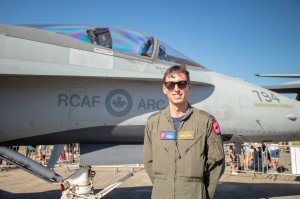
How long is your career in military aviation overall?
I've been in the military for 13 years now and flying for eight, specifically flying the Hornet since 2020.
What made you want to become a pilot? Was it your childhood dream?
It was. Started pretty young. Grade one, I saw a fellow student drawing some aeroplanes—that interested me. I started drawing aeroplanes myself and got interested in aviation. My parents started taking me to airshows just like this one, and the rest is history. Ever since, I've been looking up.
Ever since you've been looking up and now you're flying the Hornet for five years. That's cool. What is your favourite part about this aircraft?
My favourite part is flying with other countries, especially in the visual manoeuvring arena—what I call the “ephemeris.” A lot of people know it as dogfighting. Fighting with other nations’ fighter jets is always very exciting.
Specifically on the Hornet, you'll notice it has a long leading-edge extension. When I pull a lot of G—heavy manoeuvring or high angle of attack—I get these vapes, basically condensation. I can see them in my peripheral, and that's very exciting.
Sounds cool. Now let's jump into what your typical day at work looks like.
What I like about my job is that no day is ever the same. Typically, I get into work in the morning and start off with some admin—administration can be a little boring, but as an officer at the squadron, you're also in charge of running the squadron. So: emails, organisation, communication between different units.
Then, looking at the flying part, there's a lot of preparation. I spend time preparing, reviewing procedures, reviewing the weather, seeing what the airspace requirements are, coordinating with different units or squadrons to make sure the mission goes successfully.
Then it’s the formal briefing with all involved, flying the actual mission, and once we land, time for a debrief. We take our time to review everything that went on during the mission to make sure we learn from it and get better.
If there was a message you could give to young people who are dreaming of becoming pilots, what would it be?
When you're young and you're dreaming, the message I have is: keep dreaming. Hold on to that. Have fun with it. If your dream is aviation, then learn about it. Read about it. Go to airshows, museums. Hang around aviation as much as you can.
Once you're in high school, don't stress too much with the grades. It is important, but you don’t have to be a rock star—just put in effort. Try different things: play sports, play an instrument, learn different things, pick up good habits.
Once you're in post-secondary and applying to the military—and even during your military training—the key to success is consistent effort. If you do that, the odds of your dream becoming reality are very good.
Sounds easy and inspiring at the same time. Is there something about your job that people would find surprising? Maybe something that they are not expecting?
I think the most surprising thing is the amount of preparation we do as pilots. What you see in movies or at air shows is the cool part—the flying. What you don’t see is the huge amount of preparation before and the debrief after. The amount of hours we spend talking about all the details. It is very significant. I spend a lot more time on the ground than I do in the air. Sometimes it's just sitting down and reading. It’s not always the fun, exciting stuff.
If you put it into percentage, what would it be?
To give you an idea: flying twice a week is pretty normal, plus maybe one or two simulator missions. A typical flight is one and a half to two hours. The rest of the day I spend preparing. Some missions take two hours of preparation, others—more complex ones—can take a full 12 hours just for that one flight.
Wow. That's unexpected. Is there something about you that people wouldn’t expect when they see you in your flight suit?
Well, I've got a fear of heights—that might surprise some. And I'm big into endurance sports: in summer lots of long-distance running, and in winter, cross-country skiing.
|
|

Let’s dive back into the NATO Days. How do you like this event? Is it your first time here, or is it a tradition for you?
First time here at NATO Days. I absolutely love it. On arrival Friday—a beautiful day like today (Saturday)—and I spent a lot of time just looking outside. It's a beautiful part of the country.
The event is actually quite a bit bigger than I expected. Last year, I had the opportunity to go to the RIAT air show, and honestly, this reminds me of that with the amount of people and displays. A lot more than I was expecting. Very impressed.
Okay. Thank you. That concludes our interview. Is there anything you’d like to add?
To everyone who came —thank you very much. Your support is noticed and appreciated. And thank you for the warm welcome of Canada here at NATO Days. Looking forward to returning next year.
Captain, thank you very much. It was a pleasure.
Thank you. Thanks for having me.
Partners