



News
Col. Jiří Němčík, FRS MSR: Firefighting Is Not Just a Way to Make a Living // Humans of NATO Days
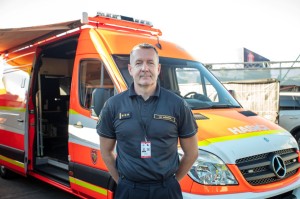
Col. Jiří Němčík has been serving with the Fire Rescue Service for more than 28 years. Starting his career as a frontline firefighter, he gradually worked his way up to become Deputy Director of the Fire Rescue Service of the Moravian-Silesian Region for the Integrated Rescue System and operational management, as well as Director of the Ostrava district department. In this interview, he reflects on his early days in the fire service, talks about the challenges of emergency response and shares his experiences from international rescue missions abroad. He also explains the role firefighters play in ensuring safety during NATO Days in Ostrava & Czech Air Force Days.
Could you introduce yourself at the beginning? Who is Jiří Němčík?
Hello. Officially, I am Col. Ing. Jiří Němčík, MBA. Within the Fire Rescue Service of the Moravian-Silesian Region I serve as Deputy Director responsible for the Integrated Rescue System and operational management, and at the same time as Director of the Ostrava district department. Within the Fire Rescue Service of the Czech Republic I also serve as a commander of units deployed for international rescue operations. On a more personal level, I am the father of two grown-up sons, I enjoy sports, and I like listening to rock music.
You have been working in the Fire Rescue Service for more than 25 years. What brought you to this profession? Was it your childhood dream?
In fact, it has been more than 28 years now. Becoming a firefighter was more of a coincidence than a childhood dream. Towards the end of my studies at a technical secondary school, I was deciding where to continue my education at university. As a native of Ostrava, VSB – Technical University of Ostrava was my first choice. When I discovered that the Faculty of Mining and Geology had a department of fire protection at that time, I realised that firefighting might be a profession I would enjoy. Although I interrupted my studies after the first year — during which I completed basic firefighter training and obtained certification for independent firefighter duties — I already knew this was the direction I wanted to take in my professional life. In 1998, I joined the Fire Rescue Service of the City of Ostrava and later completed my university degree through distance learning at the newly established Faculty of Safety Engineering at VSB–TUO.
Do you remember your first emergency call and how you experienced it?
To be honest, I probably don’t remember the very first one — it likely wasn’t anything major. But I clearly remember the rush of adrenaline when you drive to an incident with the blue lights on. I also remember my first fires and vehicle extrications, when you begin to realise how well you are able to handle pressure and stress in highly demanding situations.
What is the most difficult part of a firefighter’s job that the public often doesn’t see?
In my opinion, it is the level of risk firefighters face on a daily basis combined with the extremely wide range of incidents we must be prepared to deal with. This requires extensive theoretical and practical knowledge and skills, as well as a certain degree of flexibility and improvisation in some situations. All of this happens under time pressure and with the aim of minimising risks both for those we are rescuing and for the firefighters themselves.
What has this job taught you about people?
I see it from two perspectives. The first concerns firefighters themselves. I believe this job cannot be done simply as a way to earn a living — you need something inside you that makes it meaningful to risk your own health or life for others. I would say that although we are all different personalities, when it comes to an emergency everyone gives their best and we can rely on each other completely. The second perspective concerns the people we help during incidents. Most of the time we encounter positive reactions. In some cases people take our work for granted, and unfortunately there are also situations where some individuals misuse the services of firefighters and react negatively when we cannot meet their requests.
How has your perspective on firefighting changed during your years of service?
Naturally, my perspective has evolved with experience and especially with career progression. Over time you become more deeply involved not only in operational response but also in administrative and legislative matters, as well as management responsibilities.
What are you most proud of in your career?
There are several things. First of all, my professional journey — working my way up from a frontline firefighter to my current position. I am also proud of having served as an incident commander during the wildfire in Bohemian Switzerland, and as a unit commander during deployments to floods in Bosnia and Herzegovina, the earthquake in Türkiye, and major wildfires in Greece and North Macedonia. I also share my experience during international exercises, where I work as a trainer preparing foreign teams for rescue operations within the EU Civil Protection Mechanism.
You are the Director of the Ostrava district department. What does that role involve?
As I mentioned earlier, I serve as Deputy Director responsible for the Integrated Rescue System and operational management, meaning I oversee all matters related to operational firefighting within the region. At the same time, as Director of the Ostrava district department I am responsible for the operation of six fire stations located across the city. Given the size of Ostrava and the diversity of incidents connected with its industrial character, motorway and railway transport, and major rivers, the number of emergency responses in the city alone each year exceeds that of some entire regions in the Czech Republic, so there is certainly no shortage of work.
What does your typical working day look like? And how does it change during NATO Days in Ostrava & Czech Air Force Days?
My regular working day mainly involves administrative duties connected with maintaining the operation of specialised departments and fire stations, as well as meetings with partners, representatives of other Integrated Rescue System units, local government officials and other organisations. The Fire Rescue Service of the Moravian-Silesian Region is also very active in various projects, which is another area I am involved in. On some days I also serve as the duty command officer for the Ostrava district or as the regional command officer, meaning I take command during large-scale incidents that require higher alarm levels and strategic management due to their scale or complexity. During NATO Days, I work within the staff coordinating the activities of Integrated Rescue System units responsible for ensuring the safety of the event.
Could you explain the role firefighters play during NATO Days in Ostrava & Czech Air Force Days?
Apart from static and dynamic equipment displays, we operate a mobile command centre during the event. This vehicle is staffed by two dispatchers from the regional operations and information centre who have online access to the operational command system and can deploy firefighting units if necessary. All activities operate under an approved cooperation system involving the Police of the Czech Republic, the Emergency Medical Service, the Czech Armed Forces, private security agencies and others. In addition, fire safety patrols and forward-deployed volunteer fire brigade units are present throughout the event to ensure an immediate response to any fire or incident requiring our assistance.
Is there anything that might surprise visitors about the work of firefighters during the event — or outside it?
Through our static and dynamic displays we try to present new technologies and specialised equipment that many visitors may not even know exist. Every year we also have a prevention and education stand where visitors can try various interactive activities, including those using virtual reality, or learn about the most common causes of fires. Recently, fires involving electric scooters and e-bikes have become an increasingly significant issue.
Do you have any memorable moments from NATO Days?
For me, NATO Days are always a very important event. Apart from my professional responsibilities, it is also an opportunity to see trends in defence and security, which is a very relevant topic in today’s geopolitical situation. It is also a place where I can meet many interesting and notable people.
NATO Days highlight international cooperation, and you are also involved in international rescue operations. What is your role there?
In international rescue operations I serve as a commander of specialised response units. These include Urban Search and Rescue (USAR) teams for locating people in collapsed buildings, Water Search and Rescue (WASAR) teams using boats, forest firefighting units using vehicles, helicopter-based firefighting teams, and high-capacity pumping modules. Thanks to the experience gained mainly from real deployments, I also work as a trainer during international exercises, preparing foreign teams to reach the level required to effectively operate during large-scale emergencies.
How does an operation such as the wildfire in Bohemian Switzerland differ from missions abroad, for example in Türkiye?
The main difference lies in the nature of the incidents themselves, but also in the level of coordination and cooperation between responding units. Within the Czech Republic coordination is generally easier because equipment, procedures and command structures are largely standardised. During international missions the situation is more complex. Different countries use different procedures, technologies and equipment, and language barriers can create communication difficulties. That is why organisations such as the United Nations in the field of USAR teams and the EU Civil Protection Mechanism for other teams work to standardise procedures and equipment through certification and classification systems. It is important to remember that the affected country’s emergency services are usually already exhausted, so the main task of international teams is to integrate into their command system and provide effective assistance while remaining as self-sufficient as possible.
What would you say to someone who dreams of becoming a professional firefighter?
As someone who has dedicated his entire professional life to firefighting, I would encourage them to pursue it. If you truly have the heart of a rescuer, this job — or rather this calling — can be incredibly fulfilling. At the same time, it requires excellent physical and mental fitness, a willingness to learn new things and an awareness of the possible risks involved.
Is there anything you would like to add for our readers and visitors?
Finally, I would like to wish the organisers of NATO Days that the conditions allowing this important event to continue will always remain in place, and I hope visitors will always be able to enjoy a great experience — ideally with good weather. And for all of us, I hope that the equipment on display will only ever be used for demonstration purposes.
Partners














.jpg)